
How Advanced Materials Are Unlocking Scalable, Low-Carbon Energy Systems
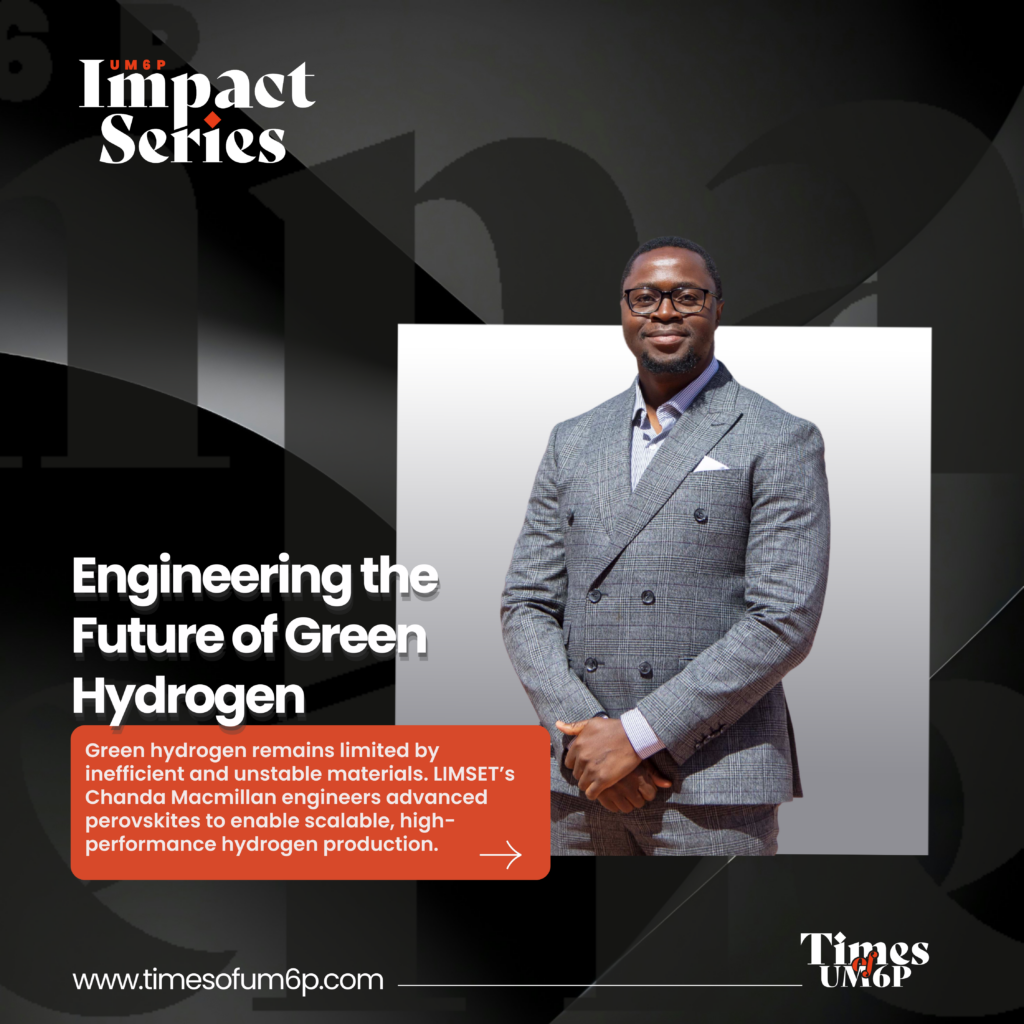
As the world accelerates toward a low-carbon future, green hydrogen is emerging as a key pillar of the global energy transition. Yet behind this promise lies a critical challenge: the need for materials capable of operating under extreme conditions while maintaining efficiency, stability, and scalability. At UM6P, Chanda Macmillan’s research explores how advanced materials engineering at the atomic scale can unlock new pathways for hydrogen production. By bridging fundamental science and real-world applications, his work contributes to building the technological foundations of a sustainable energy future.
Why it Matters
Green hydrogen is often described as a pillar of the future low-carbon economy. Why are advanced materials so critical to making this promise a reality?
Green hydrogen production fundamentally depends on materials that can efficiently drive the chemical reactions involved in water splitting. At the heart of most hydrogen technologies are catalytic and redox materials that must operate under demanding conditions, high temperatures, reactive environments, and repeated redox cycling. Advanced materials determine key performance metrics such as reaction kinetics, energy efficiency, durability, and cost. For example, the ability of a material to transport oxygen ions, activate water molecules, and maintain structural stability directly controls hydrogen production rates and system lifetime. Without materials that combine catalytic activity with long-term stability, large-scale hydrogen generation becomes energetically and economically unfeasible. Therefore, materials innovation is not simply a supporting component of hydrogen technology it is the enabling foundation that determines whether green hydrogen can become a scalable, low-carbon energy carrier.
The Scientific Breakthrough
Your research focuses on transition-metal-doped perovskite oxides for high-temperature hydrogen production. What makes these materials innovative compared to conventional solutions?
Perovskite oxides offer a uniquely flexible crystal structure that allows precise tuning of electronic and catalytic properties through chemical substitution. By introducing transition metals such as Fe, Co, and Cu, we can engineer the electronic structure of the material and control properties such as oxygen mobility, redox capacity, and metal-oxygen covalency.
This tunability is particularly important for high-temperature processes like thermochemical water splitting. The doped perovskite framework enables reversible oxygen exchange while maintaining structural integrity during repeated oxidation-reduction cycles. This stability is essential for maintaining catalytic performance over long operational lifetimes.
Compared to conventional materials that often suffer from phase instability or limited redox flexibility, transition-metal-doped perovskites provide a platform where electronic structure, defect chemistry, and catalytic activity can be systematically optimized. This makes them promising candidates for next-generation hydrogen production technologies.
From Lab to Energy Systems
How does your work bridge fundamental materials for science and real-world applications such as Solar Thermochemical Water Splitting (STWS) and Solid Oxide Electrolysis Cells (SOECs)?
My research combines computational modeling and experimental characterization to understand how atomic-scale properties influence macroscopic energy systems. Using density functional theory and structural analysis, we investigate descriptors such as oxygen vacancy formation energy, metal-oxygen covalency, and electronic band alignment.
These properties directly influence how materials behave in technologies such as Solar Thermochemical Water Splitting (STWS) and Solid Oxide Electrolysis Cells (SOECs). For example, oxygen vacancy formation determines how readily a material can participate in redox cycles, while oxygen ion mobility affects the efficiency of electrochemical reactions in SOEC electrodes.
By identifying these structure-property relationships, we can rationally design materials with improved catalytic activity and durability. This approach helps move hydrogen technologies beyond empirical material discovery toward predictive design, accelerating the transition from laboratory research to practical energy systems.
Overcoming Barriers
What are the main technical obstacles currently limiting large-scale green hydrogen production, and how does your research address them?
Despite rapid progress, several technical challenges remain. One major limitation is the efficiency and durability of materials operating under extreme conditions. High-temperature hydrogen production systems must withstand thermal cycling, chemical corrosion, and mechanical stress while maintaining catalytic performance. Another challenge is the energy cost associated with oxygen exchange and reaction kinetics. If the redox reactions are energetically unfavorable, hydrogen production becomes inefficient.
My research addresses these challenges by focusing on electronic structure engineering. By tuning the interaction between oxygen 2p orbitals and transition-metal 3d states, we can enhance metal-oxygen covalency and reduce the energetic barrier for oxygen vacancy formation. This improves redox activity and facilitates faster reaction kinetics while maintaining structural stability. Understanding these fundamental mechanisms provides a pathway for designing materials that are both efficient and resilient in high-temperature hydrogen systems.
Scalability & Sustainability
Your work emphasizes earth-abundant and cost-effective materials. How important is material scalability in accelerating the global deployment of green hydrogen technologies?
Material scalability is essential for the economic viability of hydrogen technologies. Many high-performance catalysts rely on scarce or expensive elements such as platinum or iridium. While these materials can deliver excellent performance at laboratory scale, they are not suitable for widespread deployment. Perovskite oxides composed of abundant elements such as iron, cobalt, aluminum, and copper provide a more sustainable alternative. These materials can be synthesized using well-established ceramic processing methods and are compatible with large-scale manufacturing. Developing high-performance materials from earth-abundant elements ensures that hydrogen technologies can be deployed globally without creating new resource constraints or supply chain vulnerabilities.
Climate & Energy Impact
In what ways could breakthroughs in high-temperature perovskite materials contribute to reducing carbon emissions and strengthening climate resilience?
High-temperature perovskite materials can enable more efficient hydrogen production pathways that integrate renewable energy sources such as concentrated solar power and industrial waste heat. By converting thermal energy into chemical fuel, these systems offer a route to decarbonize sectors that are difficult to electrify directly.
Hydrogen produced through thermochemical cycles or solid oxide electrolysis can serve as a clean fuel for heavy industry, long-distance transportation, and energy storage. This reduces reliance on fossil fuels and helps lower greenhouse gas emissions across multiple sectors. In addition, hydrogen infrastructure can improve energy resilience by enabling long-term storage of renewable energy, helping stabilize power systems as the share of intermittent energy sources increases.
Positioning Africa in the Energy Transition
How can innovations in advanced hydrogen materials help position Africa and institutions like University Mohammed VI Polytechnic as leaders in sustainable energy technologies?
Africa possesses exceptional solar resources and significant potential for renewable energy development. Coupling these resources with advanced hydrogen technologies creates an opportunity for the continent to become a major producer of green fuels. Research institutions such as Mohammed VI Polytechnic University play a critical role in this transition by advancing materials science, training the next generation of scientists, and developing technologies tailored to regional resources and industrial needs. By investing in advanced materials research, Africa can move beyond being a consumer of imported technologies and instead become a center for innovation in sustainable energy systems.
The Road Ahead
Looking forward, what developments in materials science or hydrogen technologies do you believe will define the next decade of the energy transition?
Several developments are likely to shape the next decade. First, the integration of computational materials design and machine learning will accelerate the discovery of new catalytic materials. Second, advances in defect engineering and electronic structure control will enable more efficient oxygen-exchange materials. Finally, closer integration between materials science, system engineering, and renewable energy infrastructure will be essential for scaling hydrogen technologies.
Your Vision
If you could share one big idea that captures the transformative potential of your research, what would it be?
The central idea guiding my research is that the future of sustainable energy will be shaped at the atomic scale.”
By understanding how electrons, atoms, and defects interact, we can design catalysts and redox systems that convert renewable energy into clean fuels with unprecedented efficiency. In this sense, advanced materials are the bridge between fundamental science and global climate solutions, helping build the foundations for a carbon-neutral energy system.
Looking Ahead
This research highlights a critical reality: the success of the energy transition depends not only on deploying renewable resources, but on advancing the materials that make these technologies viable. By addressing efficiency, durability, and scalability challenges, Chanda Macmillan’s work contributes to unlocking the full potential of green hydrogen.
As global energy systems evolve, such innovations position University Mohammed VI Polytechnic and Africa at the forefront of scientific and technological leadership in sustainable energy.
Want to dive more into the research ?
Read the full article here.
Leave a Reply