
UM6P Research Develops Model to Integrate Cooperatives into Supply Chains

Supply chains are designed to move goods efficiently, but they say remarkably little about the small producers and cooperatives that sustain them. At UM6P, researcher Sabah Belil is examining how this structural omission shapes resilience and performance, drawing on fieldwork with cooperatives to understand what happens when supply chains are built without fully accounting for their smallest actors. Dr. Sabah Belil is a researcher specializing in sustainable supply chains and complex systems. She serves as Project and Development Manager at GTI, where she leads initiatives that connect engineering, sustainability, and community empowerment.

Supply chains usually enter public debate when they break. A blocked canal, a missing component, a geopolitical shock and suddenly, systems designed to remain invisible become headline news. What receives far less attention is a different vulnerability: not the fragility of logistics, but the fragility of the people embedded within them. “Most supply chains are technically efficient and socially blind,” says Dr. Sabah Belil, Project and Development Manager at the Green Tech Institute (GTI) of UM6P. “They move products very well. They move value much less fairly.”
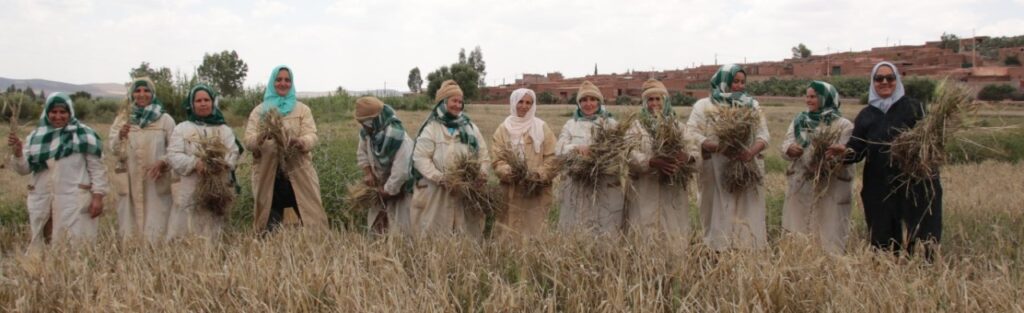
Belil has spent years working with cooperatives across Morocco and parts of Africa — women-led agro-food groups, rural producer organizations, small artisan networks — actors that supply raw materials, preserve know-how, and absorb risk, yet remain structurally marginal in value creation. Her work, anchored in applied research and field experimentation, suggests that this marginality is designed into the architecture of conventional supply chains. What UM6P is now testing, through a series of technical accompaniment and social innovation programs, is a different proposition: that the most resilient supply chains are not those that stretch furthest, but those that integrate deepest.
From Peripheral Producers to Strategic Actors
In policy documents, cooperatives are often described as “beneficiaries.” In practice, Belil argues, this framing is precisely the problem. “A cooperative is not a fragile enterprise waiting to be saved,” she explains. “It is usually a concentration of skills, local intelligence, and social capital. What it lacks is a managerial, technical, and digital structure.” Across Morocco, cooperatives have proliferated over the past decade, particularly in agriculture, food processing, and crafts. Yet their economic impact remains uneven. Many struggle to scale beyond survival, remain dependent on sporadic subsidies, or fail to integrate into formal markets. UM6P’s approach, developed through GTI and initiatives such as the Transfert Technologique Seed Fund Research (TTSFR) program supported by OCP Foundation, starts from a simple but often neglected premise: inclusion must be engineered. Rather than offering generic training or one-off funding, the teams begin with a structured, multicriteria diagnosis of each cooperative’s operational reality: production processes, governance, financial management, digital capacity, and environmental practices.
“Without a diagnosis, support becomes guesswork,” Belil says. “You end up giving the same solution to very different problems.”

The Accompaniment Effect
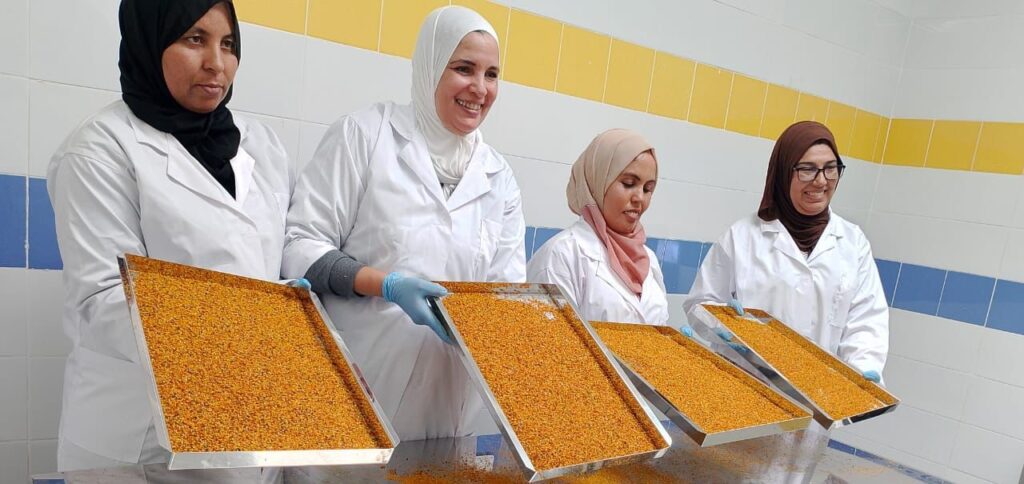
What distinguishes UM6P’s intervention is the notion of technical accompaniment as a continuous process rather than a project phase. Researchers, engineers, and field experts work alongside cooperatives over time, translating scientific knowledge into operational decisions. In practical terms, this can mean redesigning production flows to reduce waste, introducing digital traceability to meet certification requirements, or helping a cooperative reorganize internal governance so that growth does not undermine cohesion. One women-led agro-food cooperative, for example, entered the program with strong traditional expertise but chronic income instability. Through gradual technical adjustments — such as process standardization, enhanced quality control, and digital inventory tracking — it negotiated directly with downstream buyers rather than through intermediaries. Income variability decreased. Bargaining power grew. More importantly, decision-making shifted from a reactive to a strategic approach. “This is where impact becomes tangible,” Belil notes. “Not in abstract indicators, but in the cooperative’s ability to plan, invest, and negotiate.” The result is a subtle but profound shift: cooperatives stop behaving like peripheral suppliers and start functioning as nodes within a value network.
When Technology Serves Inclusion
Technology often arrives in low-income contexts as a promise and leaves sometimes as a disappointment. Platforms are deployed without training, data tools without governance, and digitalization without ownership. UM6P’s model takes a more restrained view. Technology is introduced only where it extends agency. “Digital tools are not neutral,” Belil cautions. “If you don’t design them around users, they centralize power elsewhere.” In several pilot cooperatives, simple mobile-based systems now allow members to track production volumes, trace inputs, and document compliance with environmental or social standards. These tools do not replace human judgment; they support it. Crucially, data remains controlled by the cooperative itself. The effect is cumulative. Transparency boosts internal trust. External credibility rises. And the cooperative becomes easier for partners, banks, buyers, and certifiers to understand. This is digital inclusion in its most practical sense: not connectivity for its own sake, but the ability to participate on fairer terms.
Innovation at the Margins
One of the more counterintuitive lessons emerging from UM6P’s work is where innovation actually happens. “We tend to associate innovation with startups or labs,” Belil says. “But many cooperatives are already innovating, they just don’t call it that.” A rural cooperative experimenting with solar drying to reduce post-harvest losses is not chasing disruption. It is solving a concrete constraint. Yet the implications are systemic: lower waste, reduced energy use, and higher local value retention. When such initiatives are connected to academic research through energy modeling, lifecycle analysis, or process optimization, the result is not technology transfer in the traditional sense, but co-creation. This is where UM6P’s institutional role becomes decisive. As a university structured around applied science and social impact, it can convene engineers, economists, social scientists, and community actors around shared problems. The cooperative becomes both a beneficiary and a research partner.
Scaling Without Dilution
The challenge, of course, is scale. “Scaling inclusion is not about copying solutions,” Belil says. “It’s about replicating methods.” The method UM6P is refining — diagnosis, accompaniment, digital empowerment, and partnership building — is deliberately modular. It allows interventions to adapt to different sectors, regions, and levels of maturity without losing coherence. Policy alignment matters. Public procurement rules, financial instruments recognizing cooperative governance, and certification systems adapted to small producers can amplify impact. But without grounded technical capacity at the cooperative level, policy alone remains aspirational. This is why UM6P’s strategy places science and engineering at the center of social transformation — not as abstractions, but as tools.
Redefining Performance
Perhaps the most radical implication of inclusive supply chains is what they do to our definition of efficiency. Traditional metrics reward speed, volume, and cost minimization. Inclusive models introduce different criteria: stability of income, distribution of value, environmental regeneration, learning capacity.
“These are not soft indicators,” Belil insists. “They are predictors of long-term performance.”
A cooperative that retains skilled members, adapts to shocks, and manages resources sustainably is not less competitive. It is competitive over a longer horizon. In this sense, UM6P’s work challenges a deeply embedded assumption: that fairness is a constraint on efficiency. The evidence from the field suggests the opposite. Exclusion creates hidden costs — volatility, dependency, reputational risk — that eventually surface.
Want to dive more ?
Read the full article here.
Leave a Reply