
The Classroom Reimagined by a UM6P Researcher: Professors, Students… and AI
What happens when the smartest presence in a classroom isn’t human? At UM6P, researcher Aziz Mimoudi is building a new framework for the answer. His work suggests that the greatest challenge for teachers in the age of AI isn’t mastering a new tool, but managing a new relationship, a complicated – but easy one. For two decades, a framework known as TPACK has given educators a reliable map. It charted the intersection of three fixed territories: Content, Pedagogy, and Technology. This map was drawn for a landscape of predictable instruments—digital projectors, word processors, static websites. The teacher was the cartographer, the sole navigator.
That landscape is now alive, shifting, and talking back.
The arrival of generative Artificial Intelligence in the classroom isn’t just another tool being added to the cart. It is the introduction of a new, semi-autonomous actor. Beyond displaying information, this AI generates original content, adapts in real time to student responses, and makes instructional decisions. It possesses a form of agency. And the old maps, including the venerable TPACK, are suddenly, dangerously obsolete.
This is a practical crisis unfolding in real time. Teachers are handed powerful systems with a legacy operating manual that fails to address the core questions:
- How do you manage a relationship between your student and an algorithm?
- Who is accountable when an AI tutor leads a learner astray?
- How do you preserve the human core of education when a machine can simulate empathy?
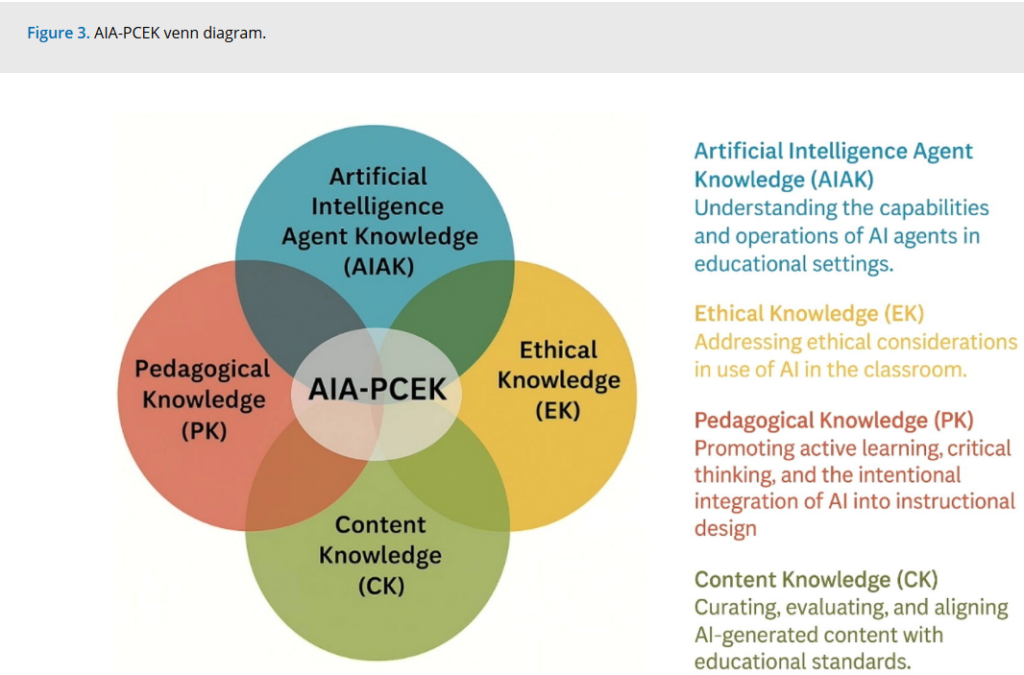
A response is emerging from an unexpected nexus of educational research between University Mohammed VI Polytechnic and The University of Texas at Tyler. It’s a new framework called AIA-PCEK (Artificial Intelligence Agent – Pedagogical Content Ethical Knowledge).
But to call it just a framework is to undersell it. It is better understood as a new constitution for the AI-augmented classroom, one that formally recognizes the new actor and establishes the rules of engagement to keep human intelligence firmly in command.
When the Tool Talks Back
The central weakness of the old TPACK model is its assumption of technological docility.
“TPACK treats technology as stable and fully controlled by educators,” explains Aziz Mimoudi, coordinator of the Digital & AI Axis at UM6P’s Institute of Education Sciences and co-creator of AIA-PCEK.
A PowerPoint slide does not reinterpret itself on the fly. But generative AI is inherently unstable, its outputs shifting with vast, unseen datasets and inscrutable algorithms. It is less a hammer and more a stray dog; potentially useful, but unpredictable and requiring careful handling.
This new reality creates problems the old framework cannot solve. Teachers are no longer just operators of technology; they are mediators of a relationship between students and an autonomous agent.
TPACK offers no guidance for biased outputs, algorithmic errors, or ethical dilemmas involving student data and fairness.
AIA-PCEK’s foundational insight is that ethics can no longer be an afterthought. It must be the spine of the entire operation. The framework formally introduces Ethical Knowledge (EK) as a core domain of teacher knowledge, equal to pedagogy and subject matter.
This transforms the educator into an ethical steward, trained to interrogate AI systems for bias, safeguard student data, and demand transparency.
The Four Pillars of a New Pedagogy
AIA-PCEK builds its model on four interdependent pillars:
1. Artificial Intelligence Agent Knowledge (AIAK)
Recognizes AI as an active actor. Teachers learn to interpret AI behavior, understand its personalisation choices, and intervene appropriately.
2. Ethical Knowledge (EK)
Places ethics at the center of AI-human interaction.
3. Pedagogical Knowledge (PK)
Expands teaching methods to orchestrate AI-driven learning, ensuring human connection and preventing AI from overshadowing creativity and empathy.
4. Content Knowledge (CK)
Teachers become curators, vetting AI-generated content for accuracy, bias, and truth, not just curriculum alignment.
AIA-PCEK is a system, not a checklist: each domain influences the others.
The Proof is in the Moroccan Classroom
AIA-PCEK is being tested through VOLCANIC, an Erasmus+ initiative training teachers in Morocco and Europe.
Teachers learned to use tools like ChatGPT quickly—but struggled where TPACK is silent:
– evaluating AI’s accuracy,
– understanding computational thinking,
– identifying ethical risks.
“Their reflections, lesson plans, and challenges… directly shaped the AIA-PCEK framework,” says Mimoudi.
The gaps observed in real classrooms became the rationale for the framework’s structure.
The Orchestrator and the Algorithm
In a history class, an AI generates prompts on the Cold War.
A TPACK-trained teacher uses them.
An AIA-PCEK-trained teacher interrogates them:
– Why did the AI choose these perspectives?
– Which voices are missing from its training data?
They use PK to turn the prompts into objects of analysis, CK to ensure rigour, and EK to surface ethical implications.
This is the rebalanced classroom, where the teacher becomes the mediator of the teacher–student–AI relationship.
The Stakes Beyond the School Gates
We are educating the first generation of AI-natives. They must learn to critically examine AI-generated content to remain informed, autonomous, and resilient.
UM6P’s work arrives at a pivotal global moment. AIA-PCEK offers a framework that is both philosophically grounded and tested in practice, acknowledging AI’s potential while protecting education’s human core.
The future is not teachers vs. technology, but a classroom where human and artificial intelligence coexist, with the teacher as mediator.
Want to dive more ?
Leave a Reply