
What Happens After You Throw Away a Cigarette Butt? The Answer Took Ten Years
Every year, trillions of cigarette butts are discarded across beaches, parks, roadsides, and waterways. Despite being the world’s most common form of litter, surprisingly little is known about what happens to them once they enter the environment. To answer this question, researchers from UM6P and international collaborators conducted one of the longest studies ever undertaken on cigarette-butt decomposition, tracking their fate over an entire decade.Most people never think twice about a cigarette butt. It’s dropped onto a sidewalk, flicked from a car window, or left behind on a beach. After a while, it disappears from sight, and with it, from memory. Many people even believe it biodegrades within a few months. But does it?
Every year, trillions of cigarette butts are discarded around the world, making them the most common form of litter on Earth. Despite their extraordinary abundance, surprisingly little research has explored what actually happens to them once they enter the environment. Do they truly disappear, or do they simply become something we can no longer see?
That simple question led Mohamed Idbella, Assistant Professor in the AgroBioSciences Program at UM6P, to embark on what would become one of the longest studies ever conducted on cigarette-butt decomposition.
“It started from a very simple observation,” says Idbella. “Cigarette butts were widely recognized as the most common waste worldwide, but there was a surprising gap: we simply didn’t know what really happened to them over the long term in real environments.”
Ten years later, the answer turned out to be very different from what most people expected.
The plastic nobody thinks about
Ask someone to name the world’s biggest plastic polluter and they’ll probably mention bottles, bags, or straws. Almost nobody thinks of cigarette butts. Yet they outnumber all of them.
Part of the reason is simple: cigarette filters don’t look like plastic. They feel soft, look almost like paper, and are often assumed to biodegrade within a few months.
That belief has persisted for decades, even though surprisingly little evidence existed to support it.
In reality, a cigarette filter is an engineered plastic product. Its main ingredient is cellulose acetate, a form of plastic designed to withstand heat, moisture, and physical stress. Each filter contains around 15,000 tightly packed microfibres that help trap chemicals from cigarette smoke and, at the same time, make the material remarkably resistant to degradation.
“The main component, cellulose acetate, is a form of plastic,” explains Idbella. “Most people, including many scientists, assumed cigarette butts degraded relatively quickly. But when we looked more closely, we realized there was almost no evidence describing what actually happens to them over the long term.”
The assumption wasn’t unreasonable. Nature is remarkably efficient at recycling organic matter. Leaves become soil. Fallen branches decay. Food scraps are transformed into nutrients.
Cigarette filters, however, follow a very different story.
A decade underground
Environmental science is often constrained by time. Research grants last a few years. Doctoral projects last a few years. Experiments rarely survive long enough to observe genuinely long-term processes. This one did.
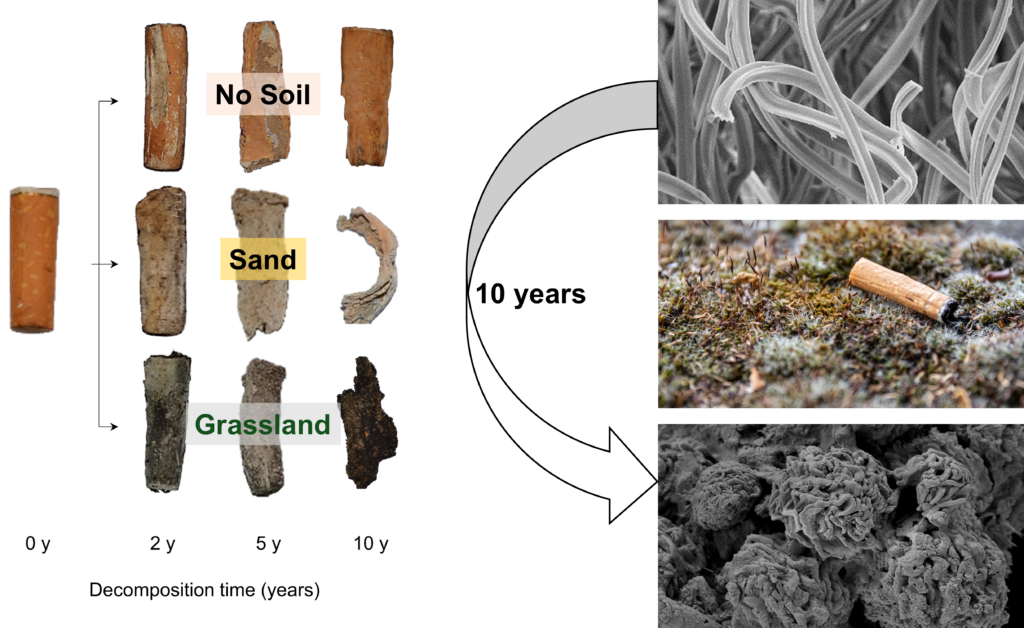
To find out what really happens to a cigarette butt, the research team monitored 12,000 cigarette butts placed under different environmental conditions, including nutrient-rich grassland soils, sandy soils, and environments largely devoid of biological activity. Samples were collected periodically over a ten-year period, creating an unusually detailed portrait of how a cigarette butt ages.
At first, the results appeared reassuring. The butts lost weight, a lot of it. In nutrient-rich environments, they lost as much as 84% of their original mass over ten years. Even under less favourable conditions, substantial degradation appeared to occur.
To many observers, that might sound like success. The pollution was disappearing.
Then the researchers looked more closely.
And the story changed.
The moment the story changed
For years, the results looked reassuring. The cigarette butts were losing weight.
They appeared to be disappearing.
Then the team looked under the microscope.
“Honestly, it was a mix of excitement and concern at the same time,” recalls Idbella.
The filters weren’t simply decomposing. They were breaking apart into thousands of tiny rounded particles resembling microplastics.
“My first thought was: we’re not solving the problem; we’re just changing its form.”
That realization changed the entire study.
We often think of pollution as something that either remains or disappears. A plastic bottle stays a bottle. A discarded tire stays a tire. Cigarette butts tell a different story.
They become something less visible, but not necessarily less persistent.
The object disappears. The material remains. What looked like decomposition was often fragmentation. What looked like disappearance was transformation. And once pollution becomes microscopic, it becomes far more difficult to detect, monitor, and remove from the environment.
The second poisoning
Most pollutants follow a predictable pattern. They are most dangerous when they first enter the environment, then gradually become less harmful as time passes.
The cigarette butt refused to follow that rule.
Fresh cigarette butts are known to contain a cocktail of toxic compounds, including nicotine, heavy metals, and aromatic hydrocarbons. As these chemicals slowly leach into the environment, researchers expected their toxicity to steadily decline.
Instead, something unexpected happened.
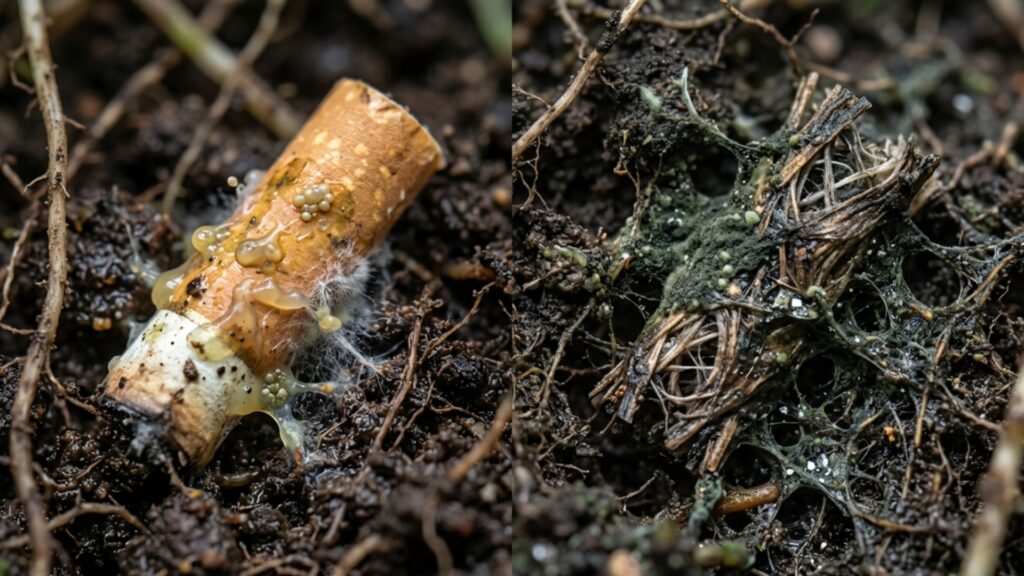
As the filters began to break apart, chemicals that had remained trapped inside the plastic became exposed once again. Rather than fading away, the pollution returned.
“It was one of the most concerning findings,” says Idbella. “We tend to think pollution behaves in a simple way. It’s toxic at the beginning, then it gradually becomes less harmful over time. What we observed was very different.”
The cigarette butt, in effect, experienced a second wave of toxicity.
That discovery challenges the way we think about pollution. Environmental impacts are often measured immediately after a contaminant is released. But some pollutants don’t follow a straight line. Their effects can change over time, re-emerging long after they appear to have become harmless.
A cigarette discarded today may still be affecting the environment years later.
The microbes that learned a new trick
For decades, cellulose acetate was considered highly resistant to biological degradation. Yet after years of observation, researchers discovered that microbial communities were adapting to the presence of cigarette filters.
Certain bacteria and fungi became increasingly specialized in colonizing and transforming the material. Microbial communities shifted dramatically between the fifth and tenth years of decomposition, suggesting that ecosystems were gradually reorganizing themselves around an entirely artificial substrate.
“The real wow moment wasn’t that microbes were there,” says Idbella. “It was what they were actually doing.”
The finding reveals something remarkable about biological systems. The microbes inhabiting modern soils did not evolve alongside cigarette filters.
Cellulose acetate did not exist during most of evolutionary history. Yet microbial communities appear capable of adapting to entirely novel materials introduced by industrial society.
The process is impressive.
It is also incomplete.
“The microbes were transforming the material, not fully mineralizing it,” says Idbella. “You get this paradox: life is slowly breaking it down, but in doing so, it’s also reshaping it into new forms that persist in the environment.”
Nature, it turns out, is trying to solve the problem, just not fast enough.
Why beaches may be the worst place
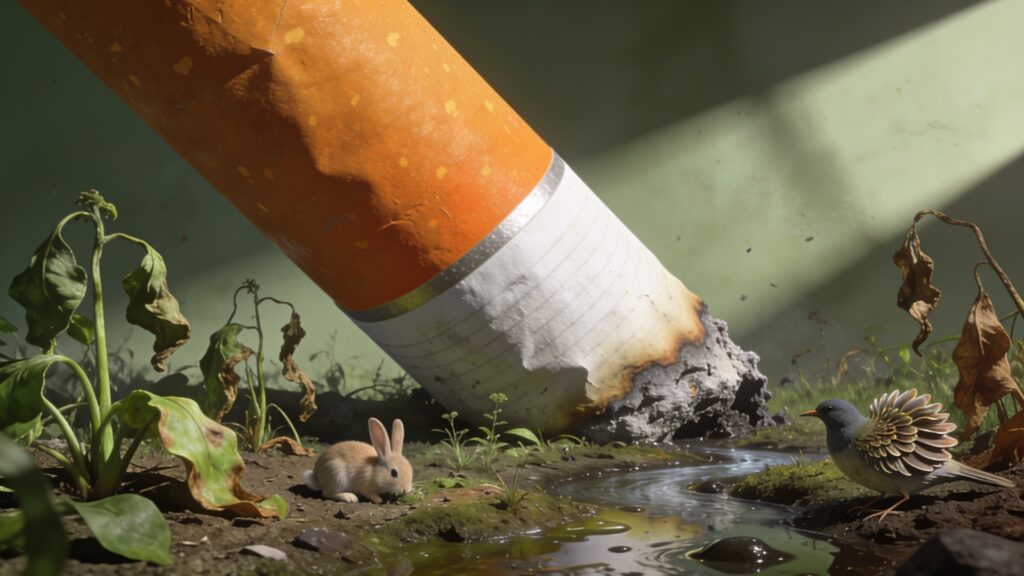
One of the study’s most important findings concerns location. Not all environments process pollution equally.
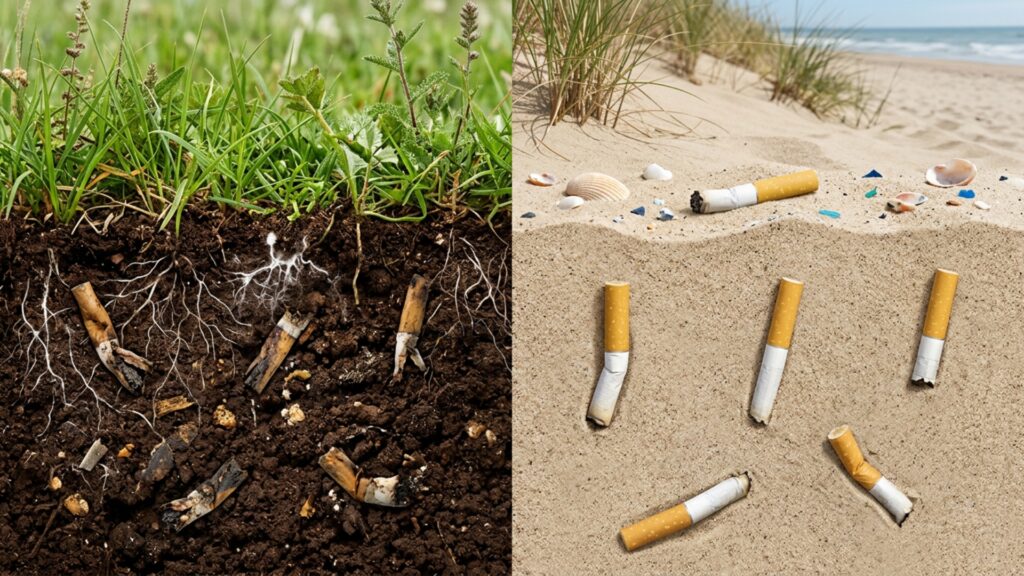
The fastest decomposition occurred in nitrogen-rich grassland soils, where microbial communities had access to the nutrients needed to attack the cellulose acetate structure. In these conditions, filters lost most of their mass.
Beaches told a different story.
Nitrogen-poor environments severely limited microbial activity. In sandy systems, decomposition slowed dramatically, leaving cigarette butts largely intact even after many years.
This creates an unfortunate coincidence. Many of the places where cigarette butts accumulate most heavily are precisely the places where degradation occurs most slowly.
“Beaches, parks, sidewalks, these are exactly the environments where degradation is the slowest,” says Idbella.
The result is a form of chronic pollution that can persist for decades.
The filter debate
The research arrives at an interesting moment. Around the world, policymakers are increasingly scrutinizing single-use plastics and producer responsibility schemes.
Cigarette filters have begun to attract attention in that debate.
For decades, filters have been marketed as a public-health feature. Environmental scientists increasingly view them as something else: one of the largest sources of dispersed plastic waste on Earth.
The scale is difficult to ignore.
Trillions of cigarette butts are discarded annually.
Even modest environmental impacts become enormous when multiplied by such numbers.
Idbella believes the conversation needs to change.
“We tend to treat cigarette butts as small, harmless litter, almost like paper,” he says. “But they’re not. They’re a plastic product that persists, transforms, and keeps interacting with the environment for years.”
That distinction matters because environmental policy often begins with classification. The way society labels a problem determines how seriously it treats it.
A cigarette butt classified as harmless litter receives one response.
A cigarette butt recognized as persistent plastic pollution receives another.
The illusion of disappearance
The most unsettling discovery from the study may also be the simplest.
After ten years, the cigarette butts no longer smelled like cigarette butts. Many of the volatile chemicals had disappeared.
The material blended into the surrounding soil.
To a casual observer, the pollution appeared gone.
That appearance was misleading.
“It gives this reassuring feeling that the system has recovered,” says Idbella. “But when we looked more closely, the picture changed.”
Modern environmental problems increasingly share this characteristic. Pollution does not always remain visible.
Sometimes it fragments, it disperses, and it integrates into ecosystems so effectively that it ceases to look like pollution at all.
The cigarette butt is merely an extreme example.
A piece of waste discarded in seconds can spend a decade rewriting itself.
Dive more into the research
Dive more into the research Here
Leave a Reply