
How Dr. Victor Ongoma is turning climate science into actionable knowledge for agriculture, water, and resilience in Africa
Across Africa, droughts, floods, and other climate extremes are placing increasing pressure on agriculture, water resources, ecosystems, and the communities that depend on them. But responding effectively to these changes requires more than knowing that the climate is changing. It requires understanding where, how, and with what consequences those changes are unfolding.
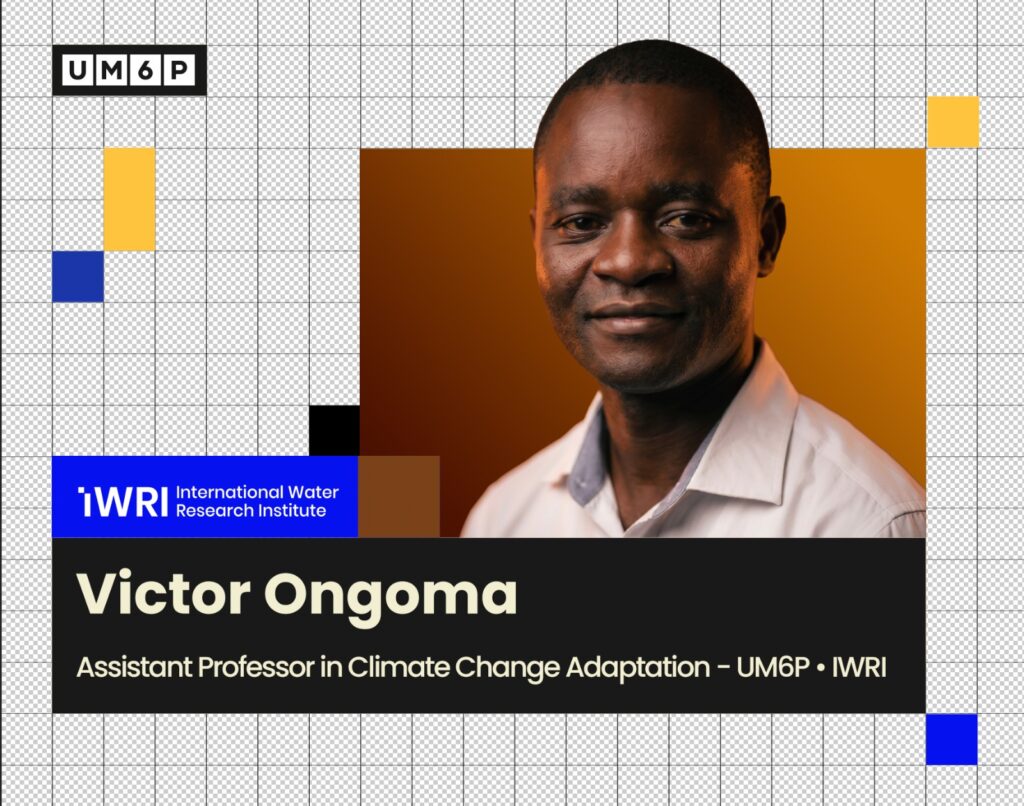
At University Mohammed VI Polytechnic, Dr. Victor Ongoma, Assistant Professor of Climate Change Adaptation at the International Water Research Institute (IWRI), is working at this intersection between climate science and decision-making. His research examines climate extremes, evaluates the performance of climate models, analyzes simulations, and explores how scientific evidence can support practical adaptation strategies.
The premise is straightforward: you cannot adapt effectively to a climate risk you do not sufficiently understand.
Understanding the Extremes
Climate change is not experienced through global averages alone. Its impacts emerge locally through changes in rainfall, temperature, droughts, floods, and other extreme events, with consequences that differ considerably between regions and sectors.
For Morocco and Africa more broadly, Dr. Ongoma’s research focuses on understanding the occurrence and impacts of climate extremes, particularly on water, agriculture, and ecosystems.
A fundamental part of that work lies in the science behind climate projections themselves: understanding how climate models perform, analyzing their simulations, and determining how their findings can be applied.
This matters because climate information becomes valuable for adaptation only when researchers understand what models can reliably tell us about the regions and systems being studied.
The objective is therefore not simply to produce more climate data. It is to generate policy-relevant scientific evidence capable of informing decisions about how societies prepare for environmental change.
From Climate Models to Climate Decisions
Climate models are among the most important tools scientists have for investigating how the climate may evolve. But translating their outputs into meaningful adaptation decisions requires careful evaluation and interpretation.
Dr. Ongoma’s work connects these different stages: model performance, climate simulations, scientific analysis, and application.
This creates what can be understood as a climate framework: scientific evidence that helps researchers and decision-makers examine vulnerabilities and identify possible responses.
The distinction is important. Climate science does not end with understanding what may change; its impact depends on what that knowledge allows societies to do differently.
For sectors such as agriculture and water, this connection between evidence and action becomes particularly significant. Better understanding of climate risks can help inform how resources are managed, how agricultural systems prepare for shocks, and which adaptation approaches deserve closer attention.
Ancient Agricultural Systems, New Climate Pressures
One of the clearest examples of this approach is the MedAgriFood Resilience Project, in which Dr. Ongoma is currently involved.
The project studies traditional food and agricultural systems across Morocco, Algeria, and Italy, focusing on three Globally Important Agricultural Heritage Systems (GIAHS).
These agricultural systems carry generations of knowledge and practices. The research asks a timely question: how resilient are these systems to contemporary environmental and socioeconomic pressures, and what can be learned from the ways they respond?
Rather than examining climate in isolation, the project adopts a multidisciplinary and integrated approach combining environmental and socioeconomic perspectives.
Its methods include literature and statistical analysis, GIS analysis, modelling of biophysical processes and cropping systems, interviews, focus groups, field investigations, laboratory analysis of soil and water parameters, and field testing of proposed practices and technologies.
Together, these approaches allow researchers to examine the systems from multiple dimensions — from climate and land use to agrobiodiversity and their social roles.
When Resilience Becomes Replicable
The potential impact goes beyond documenting whether traditional agricultural systems are vulnerable.
The project aims to identify the characteristics, practices, and mechanisms that contribute to resilience. Once effective practices are understood, they may provide lessons that can be replicated in other GIAHS sites and traditional food and agricultural systems facing similar social or environmental shocks.
This turns traditional agriculture into more than an object of conservation. It becomes a potential source of adaptation knowledge.
For Morocco and other regions confronting growing climate pressures, this perspective opens an important scientific question: could practices that have allowed agricultural systems to persist through environmental variability help inform future approaches to resilience?
The answer requires evidence — and that is precisely where the combination of climatological studies, field investigation, modelling, socioeconomic research, and biophysical analysis becomes important.
Building African Climate Knowledge into Global Science
The relevance of Dr. Ongoma’s research also extends beyond individual projects.
Based on his research experience, he has been selected as a Lead Author for the Seventh Assessment Report (AR7) of the Intergovernmental Panel on Climate Change, contributing to Chapter 2 of Working Group I.
IPCC assessment reports synthesize the scientific evidence that informs the global understanding of climate change. Participation at this level connects research expertise developed around African climate challenges with one of the world’s most important scientific assessment processes.
It also reflects a broader dimension of climate research at University Mohammed VI Polytechnic: building scientific capacity that can address regional realities while contributing to global climate knowledge.
For Africa, that connection matters. The continent faces substantial exposure to climate risks while adaptation decisions depend on evidence capable of reflecting its diverse climates, ecosystems, agricultural systems, and development contexts.
From Evidence to Resilience
Dr. Ongoma’s work illustrates why climate adaptation begins long before a policy or intervention is implemented. It begins with understanding the physical climate system, evaluating the evidence, identifying vulnerabilities, and translating scientific findings into knowledge that can guide action.
From studying climate extremes to examining the resilience of Mediterranean agricultural heritage systems, the research connects climate modelling with practical questions about food, water, ecosystems, and adaptation.
The weather may not lie. But understanding what it is telling us — and turning that understanding into decisions — requires science.
At University Mohammed VI Polytechnic, that work is helping build the evidence needed for Morocco, for Africa, and for a more climate-resilient future.
Watch the full episode on Youtube.
Leave a Reply