
UM6P Develops Rapid Test to Detect Bacteria in Chicken in 40 Minutes
In Morocco’s food markets, the chicken is often still alive when you buy it. By the five days for a laboratory to confirm if it is safe to eat, it has long since been digested. A UM6P team has built one that takes 40 minutes… and fits in a single tube.

Chicken is Morocco’s most consumed meat and, microbiologically speaking, one of its more hazardous ones. Studies place Salmonella prevalence in Moroccan poultry products at 17.9%, the highest rate in North Africa. High enough that a family sitting down to dinner has a roughly one-in-six chance of eating meat that carries a pathogen capable of hospitalising them. The country’s food safety regulations are clear on the matter: zero tolerance for Salmonella in chicken. Enforcement, however, requires detection. And detection, as practised today, takes up to five days
That is five days during which the chicken has been sold, cooked and eaten. The official method is not wrong; it is simply designed for a world in which food moves slowly enough for science to keep up. Morocco does not.
More than 90% of its chicken passes through roughly 15,000 informal retail slaughter points called ryachats, dispersed, largely unmonitored, and structurally invisible to any laboratory-dependent inspection regime. The gap between the standard and the supply chain is not a technical failure. It is an architectural one
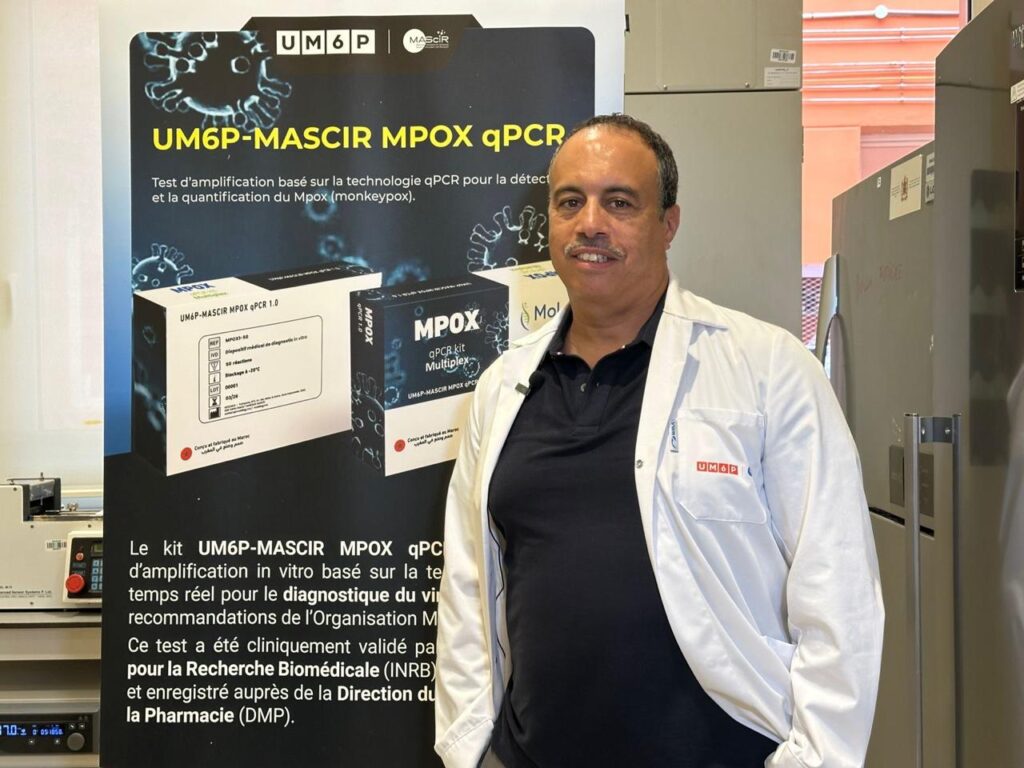
A research team at UM6P, led by Dr. Abdeladim Moumen, founder of MOLDIAG, UM6P’s diagnostic spin-off, has spent the past several years trying to close it. And they have succeeded by developing a single tube.
A question of colour
The test they developed is, in principle, straightforward. A small cube of chicken breast is washed for five minutes in a dilute sodium hydroxide solution… cheap, stable, and available anywhere that sells basic chemicals. The wash neutralises the meat’s natural acidity and ruptures bacterial cells, releasing their DNA into the liquid.
Two millilitres of that liquid are then added to a reaction mix containing a custom buffer, a strand-displacing enzyme, and six primers designed to locate the hilA gene, a genetic sequence conserved across every Salmonella serotype of clinical relevance. The tube is placed on a heating block at 65°C and left for 40 minutes.
If Salmonella is present, its DNA is amplified. The amplification releases ions that acidify the solution. The Phenol Red dye in the buffer, which began pink, turns bright yellow. If the meat is clean, the tube stays pink. No thermocycler, no extraction kit, no specialist. The result is read by eye
“We wanted to develop something rapid, simple and reliable, something that could be used closer to where contamination actually occurs,” says Dr. Moumen. The sensitivity of the finished assay, validated against serial dilutions of pure bacterial culture, reached 3.9 colony-forming units per microliter — equivalent to real-time PCR.
The problem hiding in plain sight
The colour change, elegant as it is, nearly undid the whole approach. Phenol Red is pH-sensitive. So is raw chicken, which sits between pH 5.5 and 6.5, acidic enough to push the dye toward yellow before a single strand of bacterial DNA has been touched. An untreated sample would produce a false positive by chemistry alone, making the test unreadable.
The sodium hydroxide wash solves this. At 12.5 mM — a concentration arrived at after screening several alternatives — it pushes the sample’s pH into the narrow window the assay requires. Tested across 50 chicken samples, the protocol produced pH readings clustered tightly around 7.5, with a standard deviation of 0.12.
The fact that the assay works effectively after such a simple preparation shows its robustness,” says Moumen.
“We can bypass traditional DNA extraction without compromising performance.”
The choice of target gene also reflects careful thinking. Most molecular assays for Salmonella go after the invA gene, the conventional marker. Bioinformatic analysis, however, reveals multiple small mutations in invA across strains that can cause primers to miss their mark.
The hilA gene, sitting on Salmonella Pathogenicity Island I, is more conserved. In specificity tests, the assay correctly identified four distinct Salmonella serovars and produced no signal for any of eight non-Salmonella species, including E. coli, Listeria, and Staphylococcus.
What it cannot yet do
The study’s authors are candid about the test’s limits, which is more than can be said of every diagnostic paper published in a given year. Validation used artificially contaminated samples under controlled conditions. The validation of the test is carried out in collaboration with Professor Saâdia Nassik’s laboratory at the Institut Agronomique et Vétérinaire (IAV).
Performance on naturally contaminated commercial chicken – where pathogen distribution is uneven, competing bacteria add noise, and contamination levels may be far lower than those used in the laboratory – has not yet been assessed. Regulatory approval in most jurisdictions requires detection in 25-gram samples; the current protocol has not been tested against that threshold. The test is currently being optimized to enhance its limit of detection and improve overall performance and sensitivity
The heat-treatment approach also proved less sensitive than extraction, amplifying reliably down to around 100–1,000 colony-forming units per microliter rather than 1–10. For screening at the point of
sale, where contamination levels in positive samples tend to be high, this may be acceptable. For regulatory confirmation, it is not.
These are ordinary limitations for a method at this stage. They are worth stating because the gap between a promising laboratory result and a deployed field tool has swallowed more than a few good ideas.
The structural argument
Salmonella’s persistence in African poultry is not primarily a scientific problem. The pathogen is well understood, its routes of transmission well mapped, its clinical consequences well documented.
Sub-Saharan Africa accounts for around 86% of global mortality from non-typhoidal Salmonella infections. A burden concentrated, with grim consistency, in the populations least equipped to measure it.
Morocco has the regulations. It has a national food safety body, ONSSA, with formal microbiological standards. What it does not have is a detection method that can operate at the scale and in the environments where most of its chicken is sold. A five-day culture method is not a surveillance tool in a market where turnover is measured in hours.
“If widely adopted,” says Moumen, “this approach could significantly reduce foodborne illnesses and strengthen food safety systems at the level of everyday life.
” That is a large claim. It is also, considered against the alternative – a gold-standard method that arrives after the fact – a rather modest one.
Whether the test reaches the ryachats depends on decisions made far from any laboratory: regulatory recognition, procurement, training, political will. Diagnostic history is littered with tools that worked in the journal and stalled in the supply chain. The UM6P team has solved the scientific problem.
Leave a Reply