
UM6P Researchers Find New Promise for Wave Energy on Morocco’s Atlantic Coast
Few renewable technologies have generated more enthusiasm, or more disappointment, than wave energy. Engineers love it. Governments periodically fund it. Investors periodically regret it. Yet in Dakhla, where freshwater is scarce but waves are abundant, researchers at UM6P think the technology may deserve another chance.
Meryiem Derraz is a Research Engineer at UM6P’s Energy4Water Center (ARC-AIR), where she develops and optimizes technologies at the intersection of water and energy, designed to perform reliably across different climatic zones.
Wave energy has spent the better part of half a century being the future. The future of electricity, the future of coastal infrastructure, the future of renewable energy. The future, unfortunately, never seemed to arrive.
Governments funded pilot projects. Startups raised millions. Engineers built increasingly sophisticated machines designed to harvest the immense energy stored in ocean swells. Then came the familiar sequence: technical complications, brutal maintenance costs, investor fatigue, bankruptcy, silence.
The ocean has a long history of humbling ambitious technologies.
Which is why a group of researchers at University Mohammed VI Polytechnic have chosen to revisit the idea. Less because wave energy suddenly became easier but because Dakhla may have become harder.
The city, perched on Morocco’s southern Atlantic coast, sits at the intersection of two forces increasingly shaping the twenty-first century: water scarcity and energy demand. One is becoming more severe, the other is becoming more expensive.
And both happen to meet on the same shoreline.
“The city needs desalinated water badly,” says Hicham Mastouri, Professor at UM6P’s College of Chemical Sciences and Engineering and head of the Energy4Water Center. “At the same time it sits on one of the most energetic stretches of coastline in Morocco.”
That observation is simple. It also happens to contain one of the most important infrastructure questions facing arid coastal regions today: Why import energy to produce freshwater when the energy source is already passing by offshore?
The expensive miracle
Desalination is one of humanity’s stranger technological achievements. For most of history, the oceans represented a limit. Water everywhere, yet none of it drinkable.
Today, more than 300 million people depend on desalinated water. Global production has more than doubled in the past two decades, surpassing 110 million cubic metres per day. Countries such as Saudi Arabia and the United Arab Emirates have transformed desalination from an emergency solution into a cornerstone of national infrastructure.
Morocco is heading in the same direction.
Years of drought have accelerated investment in desalination projects from Agadir to Casablanca and Dakhla. The logic is increasingly difficult to dispute. Climate models project growing pressure on conventional water resources across North Africa. Reservoirs fluctuate, groundwater reserves decline, demand continues to rise.
The sea, by contrast, is not running out. The problem is that desalination performs a curious act of accounting. It solves a water problem by creating an energy problem.
Modern reverse-osmosis plants typically require between three and four kilowatt-hours of electricity to produce a single cubic metre of freshwater. Multiply that across millions of cubic metres, and the result is an industrial process whose economics increasingly depend on electricity prices.
Humanity solved the chemistry decades ago but the electricity bill remains under discussion.
For countries investing heavily in desalination, this changes the nature of the challenge. Water security becomes inseparable from energy security. A desalination plant is no longer merely a water facility. It is also a power consumer. Or, viewed differently, an opportunity.
The renewable sector’s favourite disappointment
Few technologies inspire more optimism and frustration than wave energy. The optimism is easy to understand.
Water is roughly 800 times denser than air. A modest swell contains extraordinary quantities of energy. Unlike solar power, waves do not disappear at sunset. Unlike wind, they often remain available long after atmospheric conditions have changed.
In theory, wave energy possesses many of the characteristics engineers admire. In practice, it possesses many of the characteristics investors fear. The history of marine energy is crowded with promising concepts that performed admirably in controlled environments before encountering a less cooperative participant: the ocean itself.
Salt corrodes, storms destroy, Maintenance vessels cost money and equipment located offshore has a habit of becoming expensive at precisely the moment something breaks. The result is a peculiar contradiction, the resource is abundant the business model often is not.
Wave energy therefore occupies a unique place within the renewable-energy landscape. It is simultaneously proven and unproven. Everybody agrees the energy exists. The debate concerns whether it can be harvested economically and reliably.
Which is precisely why Dakhla has attracted attention. Less because the city possesses waves, many places do, but because it possesses waves and an industrial use for them.
The geography of opportunity
The Atlantic does not arrive gently in Dakhla. Long-period swells travel thousands of kilometres before reaching Morocco’s southern coastline.
According to the UM6P study, representative conditions can provide approximately 36 kilowatts of wave power per metre of crest, while significant wave heights frequently range between 2.5 and 3.5 metres throughout the year.
For energy engineers, those numbers matter but for infrastructure planners, something else matters more: Consistency. Solar power disappears every evening, wind fluctuates according to weather systems, waves operate according to a different rhythm.
“The swell is persistent and fairly stable year-round,” explains Meryiem Derraz, Research Engineer at UM6P’s Energy4Water Center. “Its ups and downs actually complement solar and wind rather than competing with them.”
That word – complement – may be more important than any efficiency figure.
Renewable-energy debates often assume technologies compete with one another. The reality is increasingly the opposite. Future infrastructure systems are likely to depend on combinations of energy sources capable of compensating for one another’s weaknesses.
From this perspective, wave energy’s value may lie less in how much electricity it generates than in when it generates it. For desalination facilities, which operate best under relatively stable power conditions, that distinction becomes significant.
The challenge, however, remains unchanged: can wave energy be made reliable enough to matter?
The machine beneath the surface
Most wave-energy devices have a visibility problem. Precisely because they are visible.
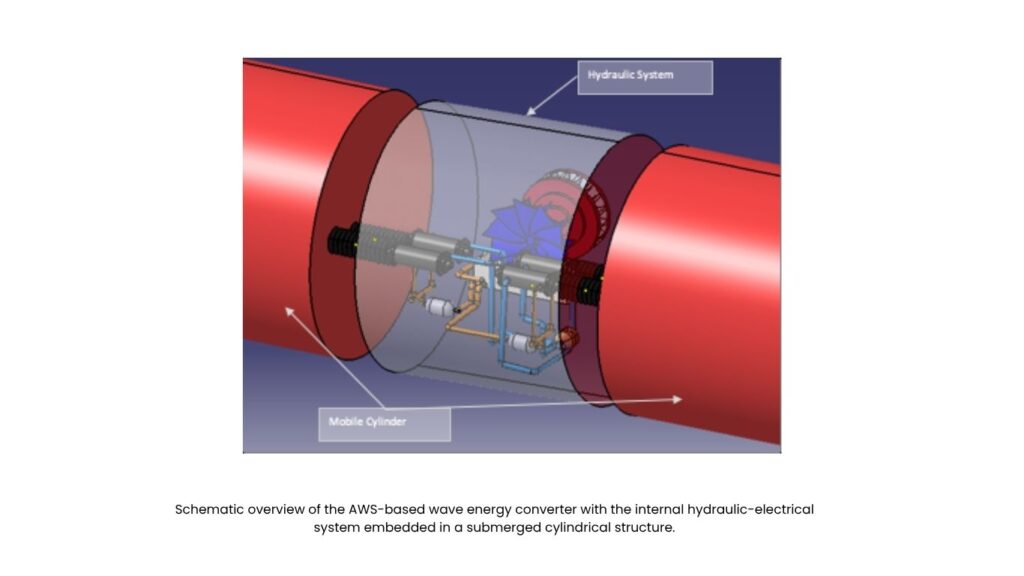
Floating structures and surface-mounted systems must endure the full force of the environment they seek to exploit. This has historically proven problematic. The Archimedes Wave Swing approaches the issue differently. It hides.
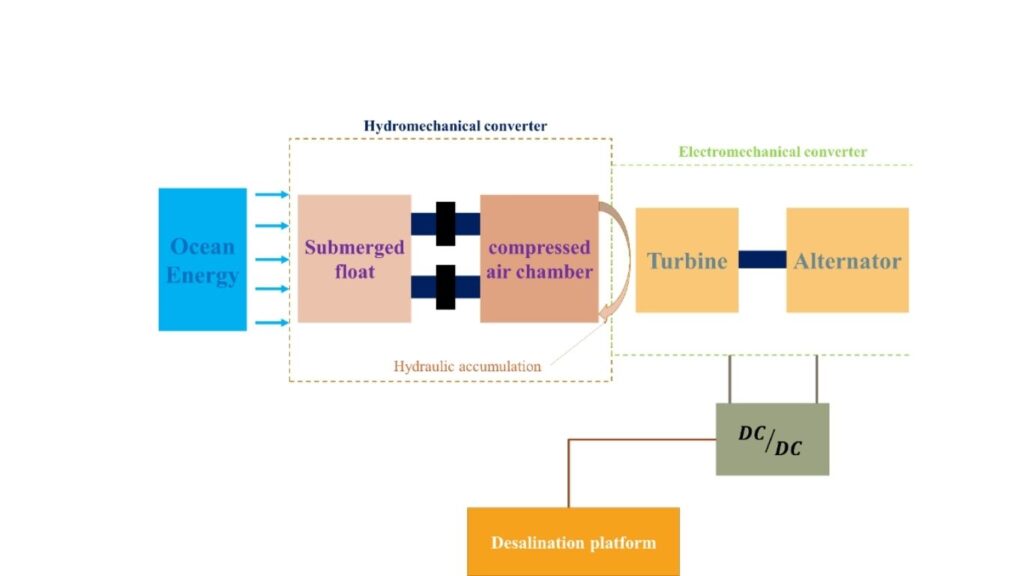
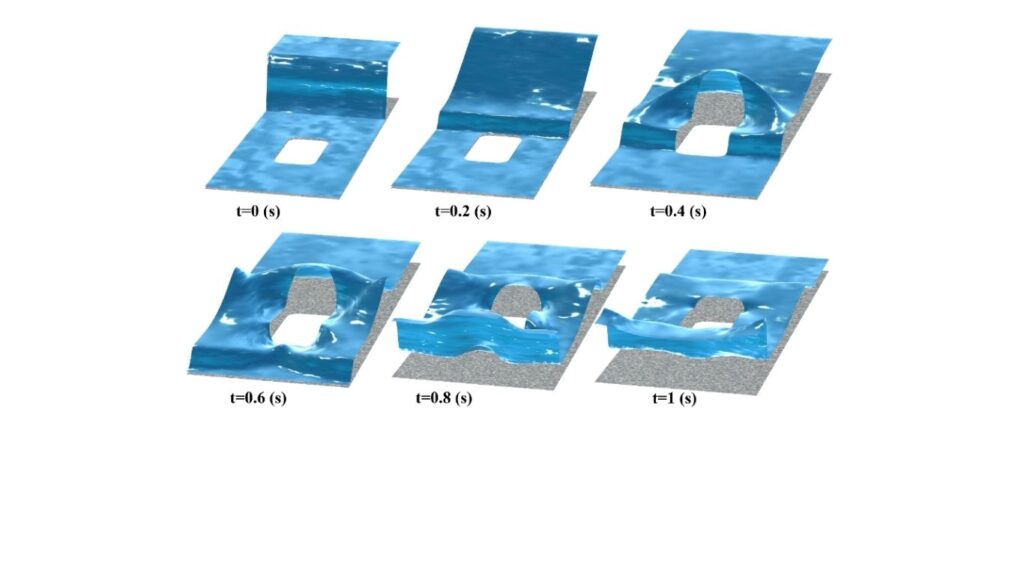
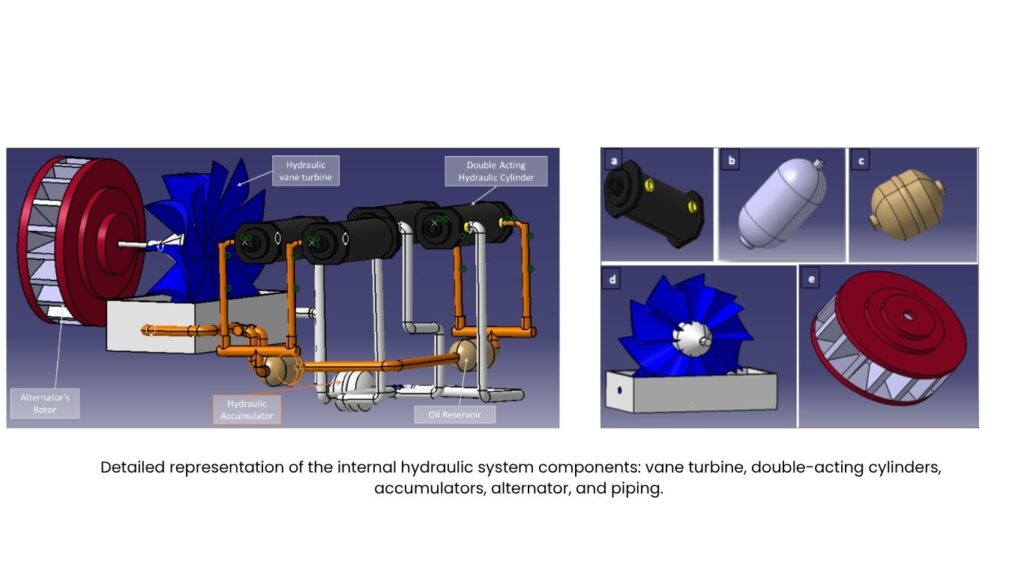
The device operates entirely below the surface. Instead of riding waves directly, it responds to pressure variations generated as swells pass overhead. Those pressure changes move a submerged float, which drives a hydraulic conversion system connected to accumulators, turbines and electrical generators.
The design is less dramatic than many wave-energy concepts. That may be its greatest strength.
“We picked the Archimedes Wave Swing on purpose,” says Mastouri. “It’s fully submerged, so storms don’t get a chance to wreck it.”
The phrase captures an important lesson from decades of marine-energy development. Sometimes the most efficient engineering solution is not to resist the environment. It is to avoid the fight altogether.
“It works off pressure differences instead of riding the surface,” he says. “That makes it a lot tougher than most wave devices.”
Yet the researchers were not primarily interested in building a machine. They were interested in understanding whether such a machine could realistically function under Dakhla’s conditions. That required mathematics, a great deal of mathematics.
Before the prototype comes the prediction
Most technological breakthroughs receive attention when somebody builds something. The crucial work often happens much earlier.
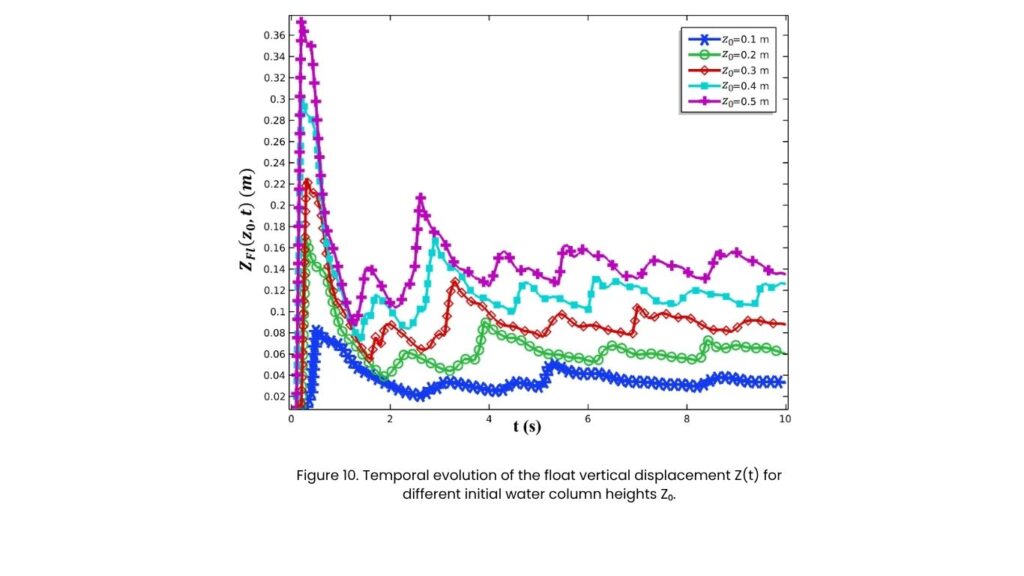
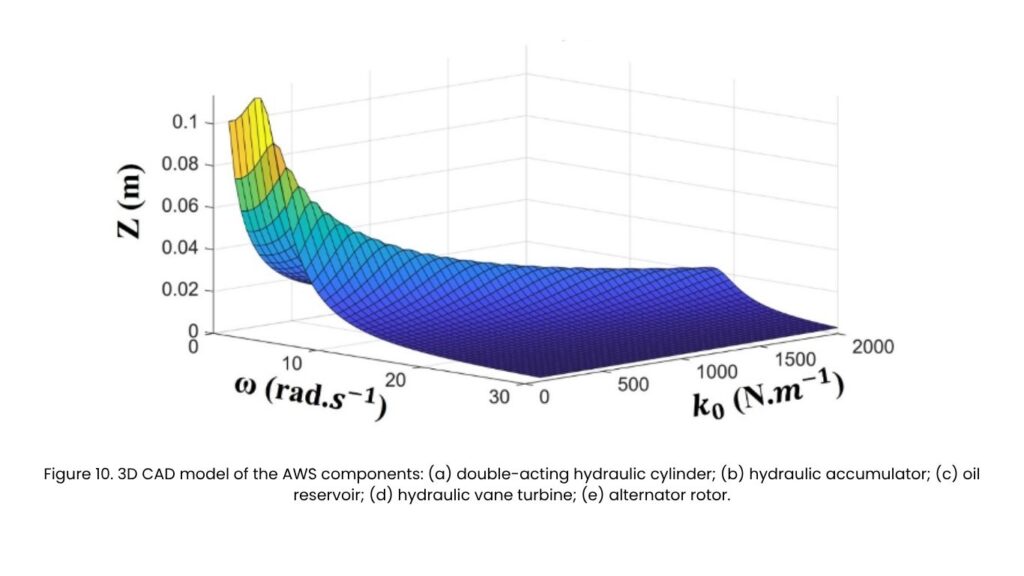
In their recent study, Mastouri, Derraz and colleagues developed analytical and numerical models describing the entire energy-conversion chain of an Archimedes Wave Swing system, from wave pressure and float displacement to hydraulic storage and electrical generation.
The objective was to understand power behaviour. Wave energy has a reputation for unpredictability. Desalination plants have little patience for unpredictability. The question was therefore whether irregular ocean motion could be transformed into something resembling stable electricity.
“What matters isn’t the raw number so much as what it tells us,” says Derraz. “The conversion chain works efficiently even at a small scale, and the power stays stable rather than spiking and dropping with every wave.”
That stability emerged as one of the study’s most important findings. Hydraulic accumulators built into the system effectively buffered fluctuations, smoothing intermittent wave motion into a more consistent electrical output.
For a scaled prototype, the team reported approximately 520 milliwatts of stable electrical generation. No one is claiming that 520 milliwatts will power a desalination plant. That would miss the point entirely.
The achievement lies in demonstrating that the underlying physics remain coherent across the entire conversion process. In engineering, confidence often begins as a mathematical result.
A continental question disguised as a local one
At first glance, this appears to be a story about Dakhla. It is not or at least not entirely.
Across Africa, urban populations continue to expand. Water demand rises. Climate variability intensifies. Governments increasingly find themselves searching for infrastructure models capable of delivering growth without importing every component required to sustain it.
This is where the significance of the research becomes easier to see. The study is not proposing that wave energy replace solar power nor is it proposing a revolutionary transformation of desalination.
Its contribution is more subtle. It asks whether future infrastructure can be designed around resources that already exist locally.
For decades, development models often relied on importing energy, importing technology, importing expertise, and then building systems around them. The emerging challenge is different.
Can regions build infrastructure that begins with what geography already provides?
In Dakhla, the answer may arrive every few seconds. The Atlantic Ocean delivers another wave, most continue their journey unnoticed. For now, at least.
The researchers at UM6P are investigating whether one of the renewable sector’s most stubborn ideas deserves another chance. Less because wave energy suddenly became fashionable again but because the questions facing water-scarce regions have become impossible to ignore.
The ocean, after all, has been offering both water and energy for millennia. The difficult part was never finding them and the waves care less whether anyone harvests them. The question is whether engineers have finally learned how.
Dive more into the research
Dive more into the research here.
Leave a Reply