
University Mohammed VI Polytechnic showcased research-driven solutions at Morocco’s largest agricultural exhibition, from soil health to alternative proteins.
UM6P Brings Agricultural Resilience to SIAM 2026
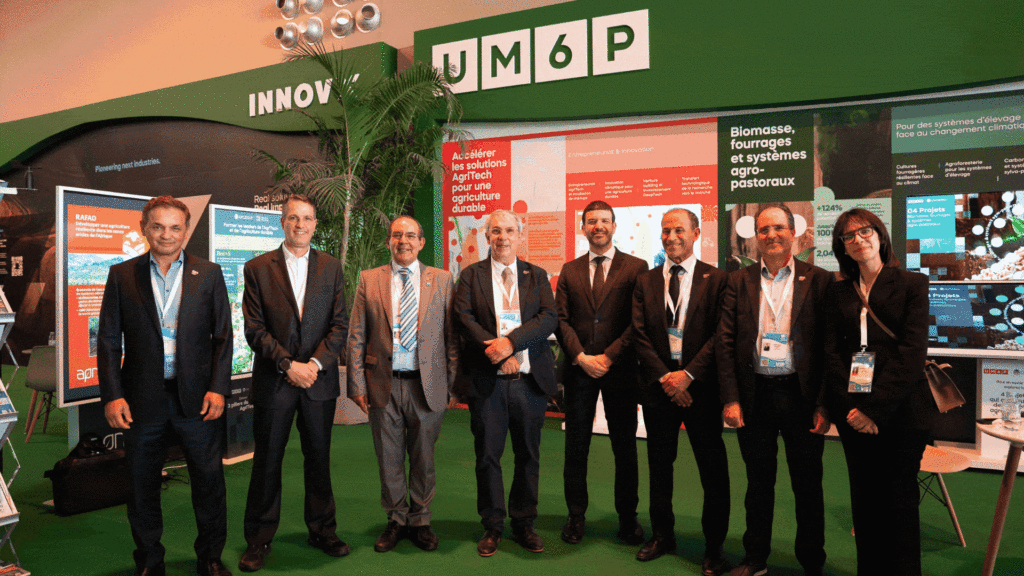
From April 20 to 28, 2026, University Mohammed VI Polytechnic took part in the 18th edition of the International Agricultural Exhibition in Morocco (SIAM) in Meknes. The event was held under the High Patronage of His Majesty King Mohammed VI. Agricultural resilience was at the core of UM6P’s participation, reflecting the university’s commitment to science-based solutions for food systems.
This year’s edition was one of the largest in SIAM’s history. It brought together 1,590 exhibitors from 76 countries, 360 foreign presenters, and 538 cooperatives. Moreover, it showed the growing international interest in Morocco’s agricultural development.
UM6P participated alongside OCP Group, its longstanding partner in agri-innovation. Together, they highlighted agriculture’s central role in broader ecosystem dynamics — from soil chemistry to water management and food security.
Research at the Core: CAES and Its Affiliated Entities
The College of Agriculture and Environmental Sciences (CAES) led UM6P’s scientific contributions at the event. Its affiliated research units covered four major domains:
- Soil health and phosphorus management
- Biomass production and resource efficiency
- Water solutions and agroforestry
- Animal nutrition and alternative feed
Each domain directly addressed critical challenges facing agriculture in Africa and the broader Global South. Therefore, the university’s presence went beyond exhibition — it served as a platform for applied knowledge transfer
Agricultural Resilience in Practice: Key Projects Shown
Several concrete projects were presented at the SIAM pavilion. These projects showed the range and depth of UM6P’s field research.
In soil management, teams showed work on soil mapping and nutrient optimization. These tools help farmers apply inputs more precisely. As a result, they reduce waste and improve crop yields.
In water solutions, UM6P presented desalination systems and atmospheric water harvesting technologies. These innovations are particularly relevant to arid and semi-arid regions, where water scarcity limits agricultural output.
In addition, the university presented advances in agroforestry, integrating trees into farming systems to improve land productivity and carbon retention.
One of the most notable areas was animal nutrition. UM6P showed innovations in feed production using insect protein and microalgae. Both offer sustainable, high-protein alternatives to conventional animal feed. Thus, they support more efficient and climate-adapted livestock systems.
From Lab to Field: UM6P’s Integrated Innovation Model
University Mohammed VI Polytechnic also used SIAM 2026 to present its broader research philosophy. The university emphasized the link between laboratory research, innovation development, and field experimentation.
This integrated model aims to produce measurable outcomes. These include improved biomass production, greater resource efficiency, and stronger agricultural system resilience. However, technical innovation alone is not sufficient. UM6P therefore highlighted initiatives focused on farmer engagement and knowledge transfer.
Furthermore, the university supported entrepreneurship within the agricultural sector. By connecting researchers, farmers, and entrepreneurs, UM6P contributes to developing scalable solutions for long-term food security.
This approach aligns with Morocco’s national agricultural strategy and reflects UM6P’s position as a leading research university on the African continent. Readers interested in UM6P’s broader research agenda can explore related coverage on Times of UM6P.
A Growing International Platform for Moroccan Agriculture
SIAM 2026 confirmed its status as a global reference point for agricultural innovation. The participation of 76 countries and hundreds of cooperatives showed the event’s growing reach. For UM6P, the exhibition offered a key opportunity to place its research within an international context.
In addition, collaborating with institutional partners like OCP Group strengthened the university’s ability to present end-to-end solutions — from soil science to market-ready technologies.
As a result, UM6P’s participation at SIAM 2026 reflected a clear institutional strategy: to connect scientific research with real-world agricultural challenges, at scale, and with measurable impact.
Leave a Reply